Mark Thompson/Getty Images
Why Hadjar is about to be hit by peak Verstappen
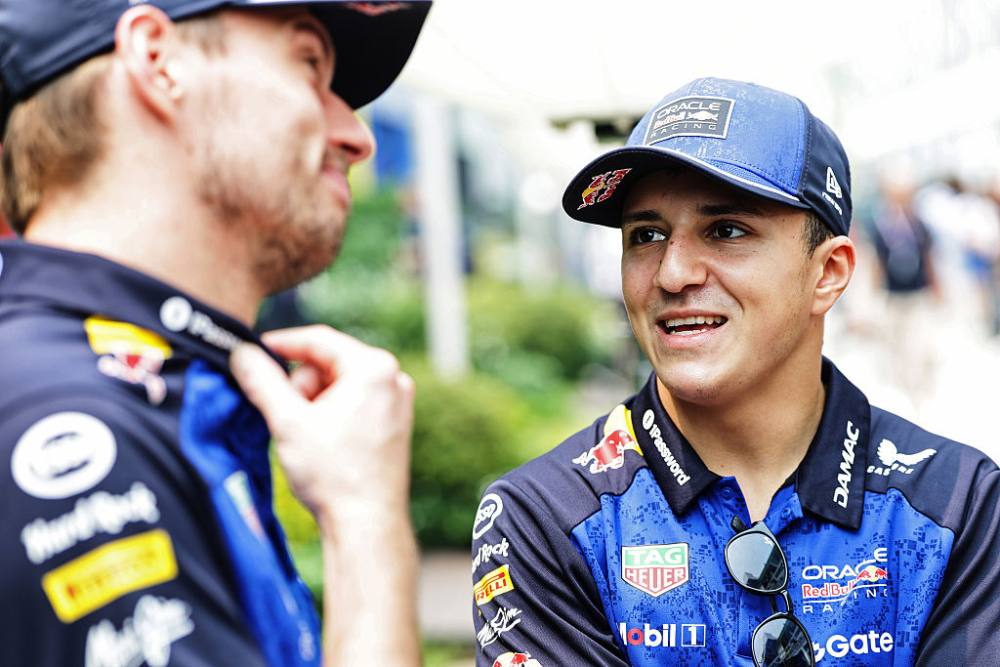
Isack Hadjar has achieved something that had seemingly become impossible in Formula 1 in recent years. He has not only survived in the hostile environment of sharing the Red Bull garage with Max Verstappen that has burned so many of his predecessors, but thrived. His deal for 2027 is already agreed, his pace has stacked up respectably well against his illustrious teammate and he’s avoided the painful fates of the previous two promoted Racing Bulls drivers, Liam Lawson and Yuki Tsunoda, who were both tried and ditched last year. Yet there have been hints in recent events that he’s about to be hit with the full force of Verstappen’s brilliance. .
Driving for Red Bull is profoundly difficult not because the second driver is ignored or poorly treated, but because of one of the inescapable facts of life in F1. If you are a very good grand prix driver alongside an all-time great, you are always at risk of looking inept and that’s the fate that, to a greater or lesser extent, Pierre Gasly, Alex Albon, Sergio Perez, Lawson and Tsunoda have all experienced in recent years. All five of them have thrived elsewhere, proving that not being at Verstappen’s level is hardly a catastrophic failure. If that were the bar for being an F1 driver, then the grid would be sparsely populated. It’s not tough because of anything Verstappen does behind the scenes, but his sheer, pulverizing pace. And this is what Hadjar might only now be facing properly following Red Bull’s recent upgrades and return to winning ways.
Hadjar is at least on a sound footing. His numbers in 2026 are good, scoring 52.4% of the points Verstappen has (this doesn’t include the three events Hadjar missed with a wrist injury). In most teams, that number would be disappointing, but in the context of Red Bull it’s very respectable. The last time any of Verstappen’s teammates reached that level was Sergio Perez in 2022, who struck at 67.2%. Of the 16 in-season teammate pairings Verstappen has been part of, Hadjar’s percentage is the sixth best. Measured by qualifying gap, counting only the occasions where a fair comparison can be made, Hadjar is just over two-tenths slower across this season. Those numbers constitute success and even though Hadjar has only twice finished on the podium, he can justifiably be satisfied with his season.
Not that Hadjar will be, because he’s famously self-critical even though there have been times when he’s allowed himself a pat on the back this season, for example after a solid start to the season despite limited pre-season test running that he described as “a bit better than I wanted”. He called the step up to Red Bull as “an easy switch” in July, and when he reflected on his season before the August break at the Hungaroring, he set himself a clear target, characterizing his single-lap pace as good but admitting that “how well he [Verstappen] is managing the races is on a different level”. That’s typical of Hadjar, who isn’t afraid of underlining the positive but will usually zero in on the areas where he hasn’t lived up to his own expectations.
“It started a bit tricky,” said Hadjar. “The first couple of rounds, I feel like I was doing the easy stuff really wrong and the tough things, like being quick, in the rhythm and not too far from Max, really well. Since the last couple of rounds, I think I've found some consistency, and in the team we've fixed a few issues that make our life easier. It's a lot easier when the car is reliable. When it's performing, it's easy to achieve results. It's good, but at the same time I would love to have a race where I can actually fight for a real podium, and that's the next target.”
He delivered on that in his next outing after Hungary, albeit having missed three races thanks to fracturing his wrist in a boxing punching bag accident. He qualified fourth and finished third in Azerbaijan, even outpacing Verstappen, who had a power unit problem, in qualifying, describing this as the “first proper podium on pure pace”. In the first stint of the race, he even had a race-pace advantage over Verstappen, although that was on the soft Pirellis while his teammate was struggling on the mediums, a trend that was flipped in the second stint.
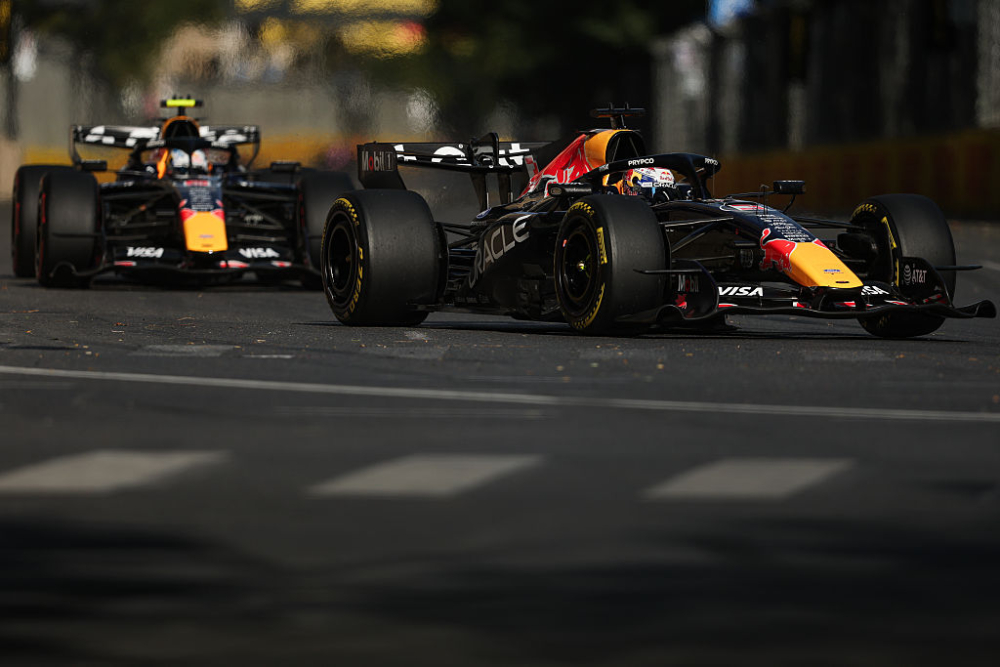
While good over a single lap, Hadjar admits his race management compared to Verstappen is lacking. Alex Pantling/Getty Images
The rest of the triple-header was frustrating. While Hadjar was third-fastest in qualifying and on course for a podium finish for much of the race despite a five-place grid penalty for an ICE change, he slipped behind the two Ferraris after the late-race safety car after struggling with deployment. Team principal Laurent Mekies described it as a “mega weekend”, but the deficit to Verstappen of 0.428s in qualifying was larger than you’d hope - as well as being in line with the pace gap between the pair at other points in the weekend.
Singapore last weekend was the messiest of all, with sprint qualifying ruined by a track-limits violation and main qualifying a waste of time thanks to gearbox failure in Q1. Although Hadjar battled back to take a hard-won point, and the fact he spent the race in traffic meant a fair pace comparison with Verstappen was impossible, there was never a point in the Singapore weekend when he looked at his teammate’s level, or even threatened to get close to the deficit of just over two-tenths of earlier in the season. Despite what Mekies called “a pretty horrific weekend on his side of the garage” in terms of the problems, there are hints that Hadjar could be tested like never before in the remaining races.
So what’s changed? Fundamentally, it’s the improvements made by Red Bull with the floor and sidepod upgrades introduced in Azerbaijan. Verstappen referred to this offering him what he called a “connected balance”, which is always ominous. In recent years, there have been times when the Red Bull has struggled on that score and it has limited Verstappen’s ability to extract superhuman pace. At times, that’s meant he’s closer to his teammate on pace than he is when the car offers him that higher, trickier-to-access, ceiling. It’s not that Verstappen is slow, but it makes life a little easier for his teammates. In this context, you’d expect Hadjar to find it more difficult.
It’s nothing to do with the car being made worse for Hadjar to suit Verstappen. After all, on his second outing after returning he said in Malaysia that “I feel like I jumped in a car that’s way better than when I left it in Budapest”. He even said he was “surprised” by how much better it was as a result of the upgrades, which contributed to his promising Baku performance. And while the weekends that followed were inconclusive, there are faint echoes of the struggles of his predecessors.
In Singapore, Hadjar tended towards braking a little later than Verstappen. It sounds counter-intuitive, but that’s often a problem his teammates face as they push to match his pace. Verstappen at his best is often a little earlier on the brakes with a corresponding earlier release, setting up the rotation of the car beautifully. He was able to do that in Singapore because he also had the rear end to ensure he got a good exit. While Verstappen has perhaps the highest level of tolerance for rear-end instability of any driver, which is a golden ticket when it comes to extracting speed, there are limits. Yet often, his teammates while trying to keep up with his pace push the braking on the entries and end up under-rotated, meaning they are not able to get the power down as early. It’s laptime-sapping, and at times all of his predecessors have struggled with this.
So far, these are only hints. Hadjar is in credit when it comes to his performances for Red Bull and with a fair opportunity, which he certainly didn’t get in Singapore, there will be a more accurate measure. But you can be sure Hadjar will have noted the signs and realize that he needs to keep raising his game to go with Verstappen now that the Red Bull RB22 is, on recent form, the class of the field.
This is where the true test for him will lie. Expectations must be realistic and nobody in their right mind will demand he matches Verstappen even though, as a driver, he will expect that. When it comes to being competitive, racing drivers must be by their very nature unreasonable in what they demand of themselves. For Hadjar, the real test of whether he can be something more than ‘just’ a good grand prix driver lies in whether he can get close to what Verstappen, at his best and more at one with the car, does. And that’s an exam that most in F1 have failed.

Edd Straw
Edd Straw is a Formula 1 journalist and broadcaster, and regular contributor to RACER magazine. He started his career in motorsport journalism at Autosport in 2002, reporting on a wide range of international motorsport before covering grand prix racing from 2008, as well as putting in stints as editor and editor-in-chief before moving on at the end of 2019. A familiar face both in the F1 paddock, and watching the cars trackside, his analytical approach has become his trademark, having had the privilege of watching all of the great grand prix drivers and teams of the 21st century in action - as well has having a keen interest in the history of motorsport. He was also once a keen amateur racing driver whose achievements are better measured in enjoyment than silverware.
Read Edd Straw's articles
Latest News
Comments
Comments are disabled until you accept Social Networking Cookies. Update cookie preferences
If the dialog doesn't appear, ad-blockers are often the cause; try disabling yours or see our Social Features Support.